Checking our bodies for unusual lumps and bumps has become a normal way of looking after our health.
But what about considering how our genes might predispose us to cancer or cognitive decline? Should we find out – even in cases where we are powerless to stop it?
It’s been more than a decade since the so-called “Angelina Jolie effect“.
In 2013, the actress announced she’d had a double mastectomy, having tested positive for faults in the BRCA1 gene, which gave her an 87% chance of developing breast cancer and a 50% chance of ovarian cancer. She later had her ovaries and fallopian tubes removed.
Jolie underwent what is called “predictive” genetic testing, whereby her significant family history qualified her for further investigations and then surgery to reduce her cancer risk.
But while genetic testing is increasingly becoming a feature for those diagnosed with cancer, NHS predictive testing for “unaffected” family members is under pressure from ever-increasing demand.
“There’s a real log jam,” says Professor Gareth Evans, medical genetics consultant at Manchester Foundation Trust and professor of cancer epidemiology and medical genetics at the University of Manchester.
If you don’t have cancer but have significant family history and, like Jolie, are approaching the age your relatives were diagnosed or died, you are referred through the NHS genetics service – instead of your hospital’s oncology department, he adds.
“If you want to be tested and you’re unaffected, the NHS doesn’t have enough genetic counsellors to cope with the number of referrals coming in,” Professor Evans says.
‘Ticking time bombs’
Tracie Miles, from the gynaecological cancer research charity Eve Appeal, describes some predictive testing cases as “ticking time bombs”.
“For unaffected patients, with say three relatives with certain types of cancer, they will be referred for genetic testing in their early 50s,” says Ms Miles, who is associate director of nursing and midwifery at the NHS South West Genomic Medicine Service Alliance.
“They’re like a ticking time bomb for those cancers, but can they get tested now? No. They’ve got to wait a year.”
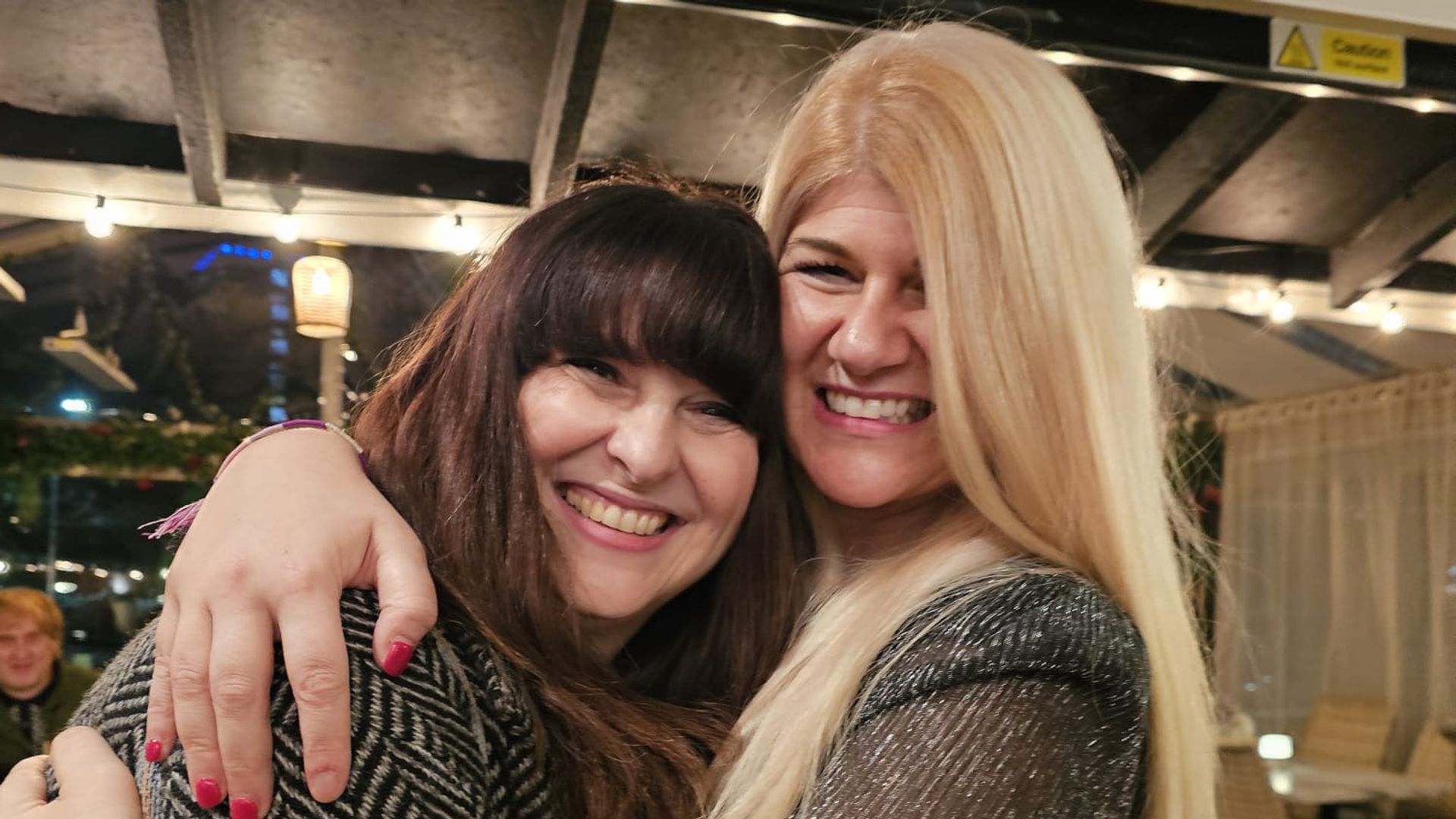
Emma Lorenz, 48, from London, says had her half-sister Carly Moosah not been turned away for NHS predictive testing in 2017, doctors may have caught both their cancers earlier and avoided her having a hysterectomy.
She was diagnosed with stage 4b ovarian cancer in July 2019, with her sister noticing a swelling under her own arm and being diagnosed with breast cancer a few months later in December.
“My sister tried to get tested on the NHS around three years before her diagnosis,” she tells Sky News.
Be the first to get Breaking News
Install the Sky News app for free
Read more:
Rise in cancer rates in young people
Spit test for prostate cancer ‘could save thousands’
Carly’s mother and grandmother both died of breast cancer in their 50s, having been diagnosed in their 40s.
Eventually private tests revealed they had both inherited faulty BRCA1 genes from their father, whose Ashkenazi Jewish heritage means a six-times greater risk of BRCA mutations than the general population.
Emma, who is now cancer-free after surgery and multiple rounds of therapy and drugs, says: “If my sister had been tested before, both our cancer stories could have been so very different.
“My late-stage diagnosis also took my choice of having children away.”
But despite being tested much later than they could have been, Emma still credits their tests with saving their lives.
“Getting my BRCA diagnosis probably ultimately saved my sister’s life,” she says.
“And because I also tested positive for the BRCA gene, I was offered an incredible pill that I would not have had access to if I didn’t.
“So on the one hand, it was a very hard diagnosis because of what it meant for my family, but on the other, it was a good thing in terms of treatment.”
The NHS offers tests for faults in the following cancer-related genes:
- BRCA1 and BRCA2 (breast and ovarian cancer)
- PALB2 (breast, ovarian, prostate, and pancreatic cancer)
- ATM (breast cancer)
- CHEK2 (breast cancer)
You qualify for testing if you:
- Had breast cancer at 40 or younger
- Had it in both breasts at 50 or younger
- Had triple negative breast cancer at 60 or younger
- Had ovarian cancer at any age
- Had breast cancer at 45 or younger and so did a first-degree relative
- Had breast and ovarian cancer at any age
- Had male breast cancer at any age
- Have at least one Ashkenazi Jewish grandparent
- Had any cancer and a Manchester score of 15 or higher (10% risk)
- Have not had cancer but have a Manchester score of 20 or higher
‘Some people would rather not know’
Predictive genetic testing is also available on the NHS for certain forms of dementia.
People who have a close relative with frontotemporal dementia, which has a proven genetic link, or several relatives with an early onset form of the disease qualify.
But with no cure for either, or various other neurological diseases such as Parkinson’s, the decision to get tested is much more complex.
“If you’ve got a cancer-causing change in the BRCA gene, you can have surgery or screenings, which reduce your chances of getting cancer,” says Dr Alisdair McNeill, NHS clinical genetics consultant and senior clinical lecturer in neurogenetics at the University of Sheffield.
“But there are currently no cures for genetic brain diseases like some rare forms of dementia, so the benefits and motivations for having that test are different to the situation of cancer running in families.
He adds that a positive test result can allow people to make more informed choices about their futures, careers, or to undergo IVF treatment to help prevent faulty genes being passed to children.
But he says: “There are some misconceptions that there are things people can do after their diagnosis – and we often have to correct them in the very sad absence of any treatment.”
The NHS says that while a predictive test result “may reduce any stress and anxiety that comes from not knowing”, “a positive result may cause permanent anxiety” and “some people would rather not know about their risk”.
The NHS offers genetic testing for dementia if:
- You have a first-degree relative who has been diagnosed with frontotemporal dementia
- You have more than one relative diagnosed with any dementia at 65 or younger
Alzheimer’s result at 27
Jayde Greene, from Hertfordshire, decided to get tested for PSEN1 gene mutations, associated with familial early onset Alzheimer’s disease, after her father, two uncles, and aunt were all diagnosed in their 40s.
She says that while she initially tried to keep her family history from her mind, the funeral of her father’s twin not long after the birth of her son Freddie in 2016 saw her get tested aged 27.
“That’s when I decided I had to know,” she tells Sky News. “So I could prepare and know how to live the rest of my life with my son.”
She received a positive result – meaning she’s at high risk of the disease – and in the days afterwards, she says she had suicidal thoughts and attempted an overdose.
“The first time I was on my own I started thinking all manner of things – that I couldn’t bear to be the way my dad was and have my son look at me like that.
“That he wasn’t even a year old yet, that if I went now, he wouldn’t remember me, and it’d hurt less.”
But she changed her mind, she says, and is now preparing to tell her son about her result when he is a teenager, before she reaches the age her relatives started showing symptoms.
“I heard my son crying and I stopped what I was doing,” she says.
“I’ve never thought that way again, but I want people to know that feeling that way is also normal.”
Now aged 34, she stresses that although she tries to remain “90% hopeful”, there are “still bad days”.
“Medicine is making leaps and bounds,” she says. “But I also keep feeling that it’s been seven years and there’s been nothing yet.
“So there are days when my hope is gone and I’m convinced at 42, like my dad, that’ll be it.”
Not enough genetic counsellors
Genetic counsellors are experts who help assess people’s genetic risk and guide them through the process of testing. There are only around 300 of them in the UK.
Professor Evans says that without their scientific expertise and psychological support, many women risk “falling apart” after a positive test result for a cancer-related gene.
But with waits of six months or a year for people who don’t already have cancer, increasing numbers are either buying testing kits online or trying to get results through private labs, which offer little-to-no genetic counselling, according to the experts.
“There is published evidence that programmes that use raw data from ancestry tests are only 50% accurate,” Professor Evans warns. “So you could be wrongly told you have a genetic fault, or if there is a fault in your family, told you don’t have one.”
These people often try to re-enter the NHS, he adds, to find it will not accept their result, meaning their waiting time starts over.
Genetic counsellors are experts in genetics that work in the NHS to help people understand:
- The risks and benefits of having a genetic test;
- The potential results of a test and what they mean;
- How family members may be affected if the test result shows a serious health condition runs in the family;
- The risk of passing on a health condition to children;
- The options if your child has an inherited health condition and you do not want your next child to inherit it.
They have usually completed a three-year undergraduate degree in genetics, followed by a two-year masters programme.
Ultimately, the decision to get tested is a personal choice, which also depends on the condition being tested for.
Professor Evans, who developed the Manchester scoring system for cancer testing, stresses the importance of genetic counselling in either scenario.
“If you carry a faulty BRCA1 or 2, your risk of breast cancer can be as high as 80% – that’s a really considerable risk,” he says. “So it’s about preparing people for the level of risk they’re going to be at.
“But if you do test positive, there’s a lot we can do about it and we can really reduce your likelihood of dying from cancer.”
Testing is ‘scary’ but ‘knowledge is power’
Kellie Armer, 34, from Lancashire, is having a preventative double mastectomy this year after testing positive for a BRCA1 mutation at 26.
She was aware of her genetic cancer risk from around 18 but says she “wasn’t mentally ready” then to get tested.
Now, having had two children and run the London Marathon for charity Prevent Breast Cancer, she says: “At 18 I didn’t want to go down that road. I was a bit too scared still.
“But now it’s about a future with my kids. Being able to see my girls grow up outweighs any selfish thing like being career-driven and not wanting to take time off work – or worrying about being unattractive.”
Emma says she found her BRCA test result distressing.
“I thought I handled my cancer as well as I possibly could,” she says. “But the thing that probably upset me the most was finding out I had the BRCA gene.
“The idea my family, including my niece and nephew aged four and six at the time, would have to think about this, or get sick in the future, deeply upset me.”
Her medical team has recommended she gets preventative breast surgery. Although she wants to wait a few more years, she knows she “can’t put it off indefinitely”.
“That knowledge is power – it’s the key that unlocks what our future health holds,” she says. “So for me, it’s better to know than hide your head in the sand and pretend it’s not happening.”
Although there is still no cure for Alzheimer’s, Jayde agrees.
“I’d never change my decision to know,” she says. “As much as it’s come with bad, it’s also come with a lot of good. If I could go back, I’d do it and find out again.”
Keep up with all the latest news from the UK and around the world by following Sky News
Experts are calling for the NHS thresholds for predictive genetic testing to be lowered and more public health campaigns around cancer and genetic risk.
Professor Evans says: “We should be expanding access to more unaffected people, but at the moment there just isn’t the manpower in NHS genetics to cope with more people coming in.”
Sky News has contacted NHS England for comment.
Anyone feeling emotionally distressed or suicidal can call Samaritans for help on 116 123 or email [email protected] in the UK. In the US, call the Samaritans branch in your area or 1 (800) 273-TALK