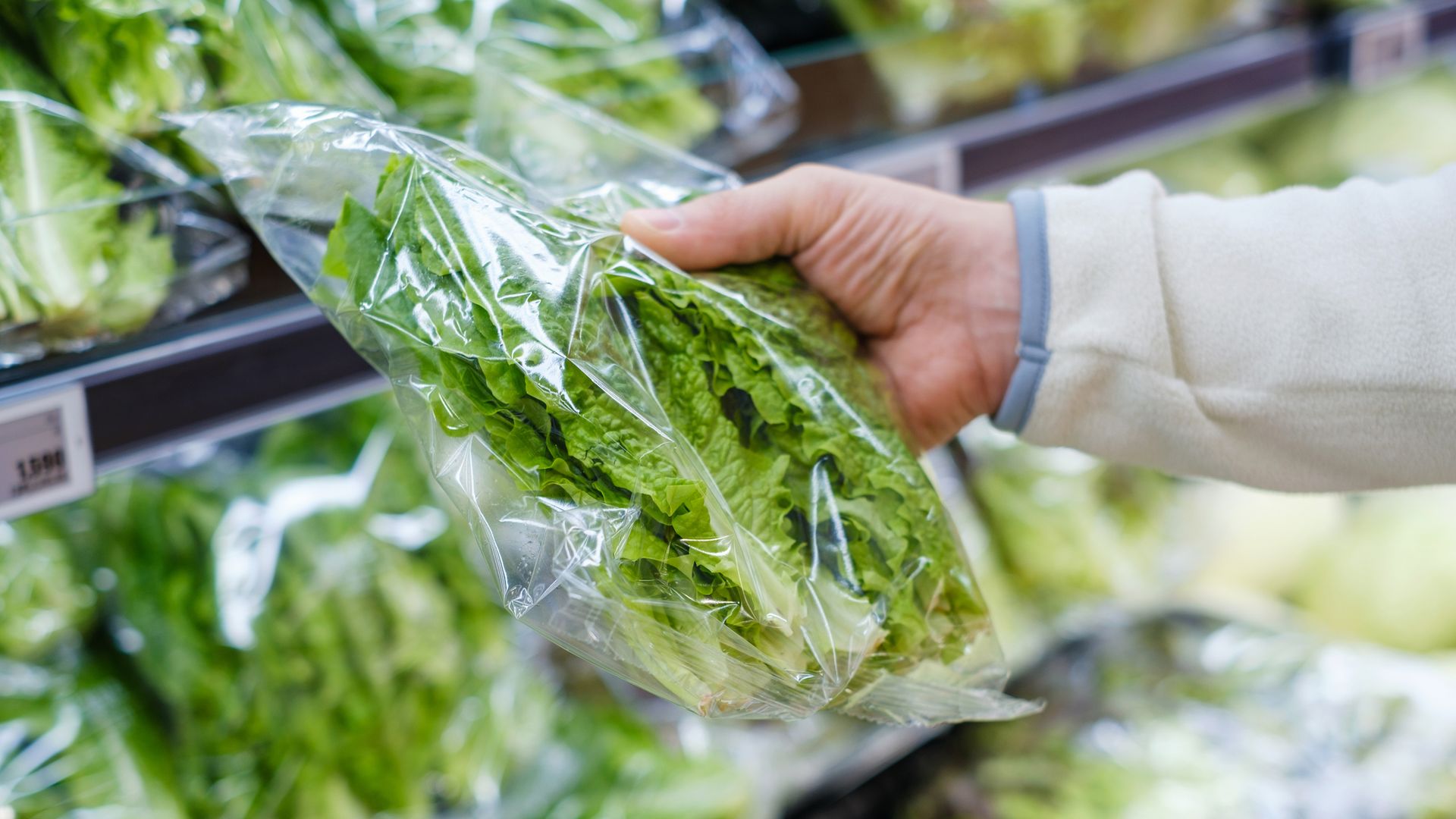
An E.coli outbreak that has made more than 200 people sick has been traced to lettuce – so is it safe to eat?
The Food Standards Agency (FSA) told Sky News it is “too early to determine” how the lettuce leaves may have become contaminated – but it is “confident” that is the source.
Three companies have recalled dozens of sandwiches and wraps sold at supermarkets as a precautionary measure.
So how can lettuce end up carrying E.coli – and does this mean a summer without salad?
How could it happen?
There are three main ways lettuce leaves could have been contaminated with E.coli, according to Professor Jim Monaghan, professor of crop science at Harper Adams University in Shropshire.
E.coli “essentially wants to be inside the guts of warm-blooded animals”, he says, but pathogenic strains can be found in between 10-15% of dairy herds – which means a minority of manure is contaminated with it.
That manure – and the E.coli it carries – can end up on lettuce leaves in cases of direct contamination.
In cases of indirect contamination, the bacteria may get into the soil or water and be transferred to the lettuce that way.
How do farmers prevent contamination?
If farmers use manure to fertilise a field, they have to wait at least a year before they can plant lettuce there.
They must also test the water they are using for irrigation to see if E.coli is present.
“For a lettuce grower, if you’re irrigating a crop with water, if you’re not comfortable drinking that water, then you wouldn’t be irrigating the crop,” Prof Monaghan tells Sky News.
That doesn’t mean they need to irrigate with chlorine-treated tap water, he adds, but it must meet an “acceptable standard”.
Salad growers will also risk assess their sites and avoid planting salad in any areas prone to flooding to avoid potential water contamination.
The FSA has not revealed whether the lettuce came from a UK-based farm or was imported from abroad.
The latest figures show 211 cases of E-coli have been confirmed as of 11 June – and at least 67 people have required hospital treatment.
Please use Chrome browser for a more accessible video player
Should you be worried about eating lettuce?
Prof Monaghan says he hasn’t changed his lettuce-buying habits in response to the recent outbreak.
“I have a bag of spinach and two whole head lettuces in my fridge at the moment. So knowing what I know about how UK growers manage their risks, to me that’s fine,” he says.
“But clearly something’s gone wrong.”
However, he notes a couple of things – beyond the usual rules growers must follow – that have reassured him about buying salad.
“One is it would appear that the product that’s caused a problem has left the supply chain,” he says.
The second is that everyone involved in salad production – from growers to salad and sandwich manufacturers – will be “sampling like crazy”.
Be the first to get Breaking News
Install the Sky News app for free
Does washing salad leaves get rid of E.coli?
Once it reaches the factory, lettuce will be rinsed to remove surface contamination. Then chlorine is used to reduce the level of bacteria before it is rinsed again.
That is “effective to a certain extent”, Prof Monaghan says, but it does not eliminate bacteria entirely.
The same goes for washing lettuce at home – it will reduce the amount of bacteria, but not get rid of it.
Read more:
What are the symptoms of E.coli infection?
Full list of products recalled by sandwich suppliers
Keep up with all the latest news from the UK and around the world by following Sky News
How does the weather have an impact?
The recent wet weather could have created conditions where E.coli can more easily survive.
On a hot, sunny day, leaves will dry off quickly, reducing the chance of water contamination.
They will also be irradiated by UV rays, killing bacteria.
But on wet, overcast days, there is not the same opportunity for bacteria to be killed off, Prof Monaghan says.
We have had a damp start to the summer – and similar weather has been seen in Spain, Italy and France – all countries that import lettuce to the UK.
Why is it so difficult to trace the root cause?
Darren Whitby, head of incidents at the FSA, said identifying the source of the E.coli was a “complex and ongoing investigation”.
Part of the reason it’s so difficult to trace is because the contaminated products are a very small proportion of the sandwiches on supermarket shelves, Prof Monaghan says.
Then there’s the fact the products in question have a shelf life of days.
“Two days after a sandwich is made, you won’t find that sandwich again,” Prof Monaghan says.
“It’s either been eaten or it’s been taken off the shelf.”
The FSA has been investigating the issue along with the UK Health Security Agency (UKHSA), Food Standards Scotland and devolved public health agencies, businesses and local authorities.
Through epidemiological investigations and whole genome sequence analysis, they narrowed down the common foods consumed by people who had fallen ill to a small number of salad leaf products used in sandwiches, wraps, subs and rolls.
Dozens of products were recalled; while no E.coli had been found in them, it was a “precautionary measure” in case they were contaminated.
The fact E.coli was not found in the products indicates it has left the supply chain but Prof Monaghan says: “There’s no smoking gun.”