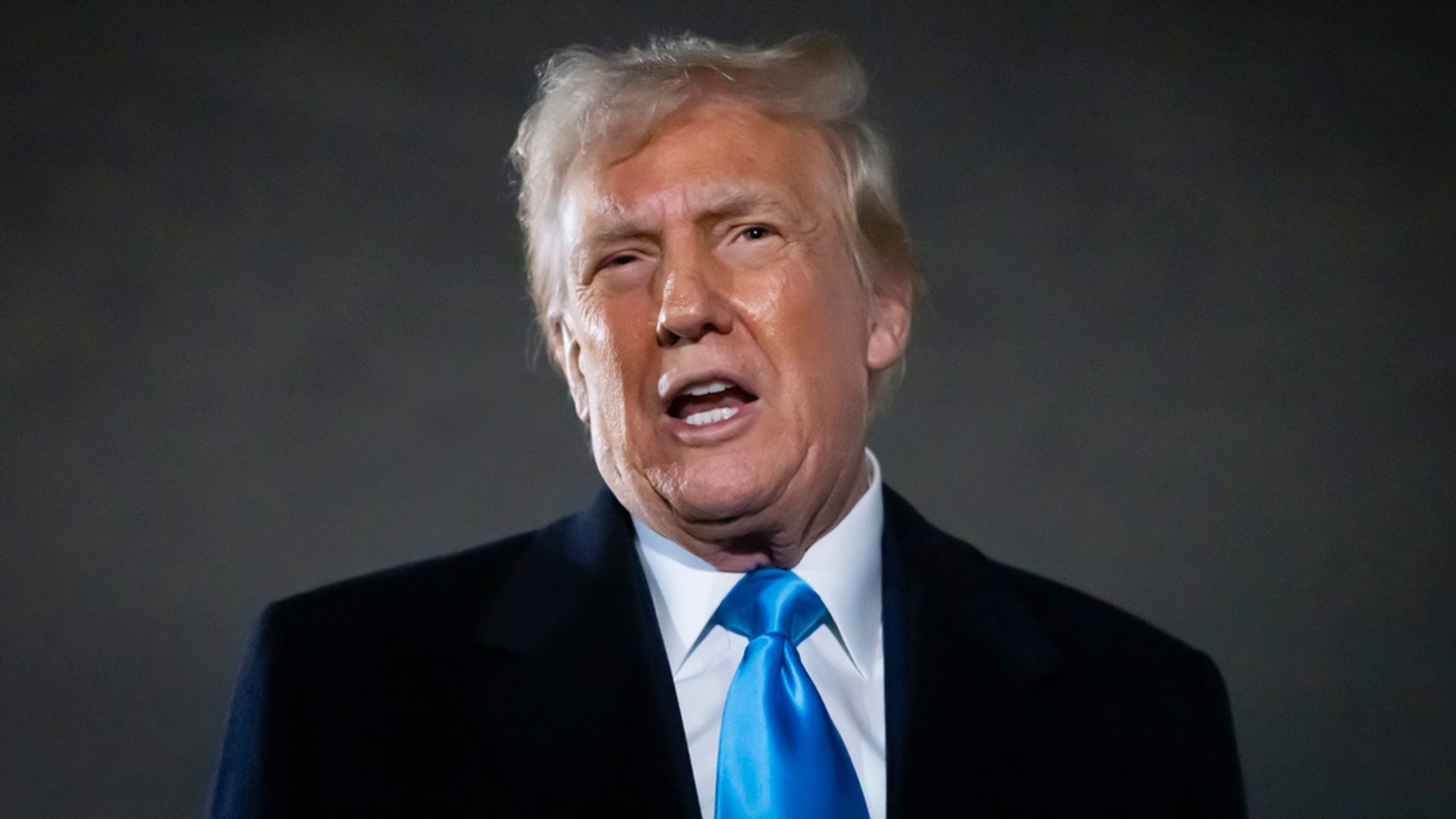
Donald Trump has ordered sweeping tariffs on Mexico, Canada and China, kicking off a trade war that will affect the globe.
Here we look at the tariffs and what they all mean for the world:
What did Trump announce?
The US president has confirmed that goods from Mexico and Canada will face 25% tariffs, while 10% taxes will be implemented on imports from China.
Canadian energy, including oil, natural gas and electricity, will be taxed at a 10% rate.
Trade war latest: Follow live updates
The levies are expected to all take effect on Tuesday, with Mexico and Canada both announcing counter-tariffs of their own in response.
Mr Trump has also threatened to go further, saying tariffs on the European Union would be implemented “pretty soon”.
Please use Chrome browser for a more accessible video player
When questioned about the UK, the president said Britain was “out of line” when it came to trade but he thought the situation could be “worked out” without the use of tariffs.
What are tariffs, and how do they work?
Put simply, tariffs are taxes on goods that are brought in from other countries.
By raising the price of imports, tariffs aim to protect domestic manufacturers by making locally made goods cheaper.
Contrary to what Mr Trump has said, it is not foreign countries that pay tariffs, but the importing companies that buy the goods.
For example, American businesses like Walmart or Target pay tariffs directly to the US treasury.
In the US, these tariffs are collected by customs and border protection agents, who are stationed at 328 ports of entry across the country.
To compensate for tariffs, companies then put up their prices, so customers end up paying more for goods.
Tariffs can also damage foreign countries as it makes their products pricier and harder to sell.
This can lead to them cutting prices (and sacrificing profits) to offset levies and maintain their market share in the US.
Why is Trump doing this?
Mr Trump has argued that imposing higher levies will help reduce illegal migration and the smuggling of the synthetic opioid fentanyl to the US.
On Mexico, the US leader claimed drug traffickers and the country’s government “have an intolerable alliance” that in turn impacts national security.
He further claimed that Mexican drug cartels are operating in Canada.
On China, he said the country’s government provides a “safe haven” for criminal organisations.
He has also pledged to use tariffs to boost domestic manufacturing.
“We may have short term some little pain, and people understand that. But long term, the United States has been ripped off by virtually every country in the world,” he said.
His aim appears to be to force governments in those countries to work much harder to prevent what he calls illegal migration and the smuggling of the deadly drug fentanyl. But, even if the countries do not do what America wants, it will still potentially benefit firms that produce goods in the US.
What could the consequences be?
Mexico and Canada are two of America’s largest trading partners, with the tariffs upending decades-old trade relationships.
Goods that could be affected most by the incoming tariffs include fruit and veg, petrol and oil, cars and vehicle parts and electronic goods.
New analysis by the Budget Lab at Yale University found that the average US household would lose the equivalent of $1,170 US dollars (£944) in income from the tariffs.
Read more: This is how US consumers will be affected
Please use Chrome browser for a more accessible video player
The research also found that economic growth would slow and inflation would worsen, as the tariffs forced up prices.
Immediate consequences were felt on Monday morning, as shares on Asian markets took a tumble.
Japan’s Nikkei opened down 2.9% while Australia’s benchmark – often a proxy trade for Chinese markets – fell 1.8%. Stocks in Hong Kong, which include listings of Chinese companies, fell 1.1%.
UK stocks were also significantly down, with the benchmark FTSE 100 index – containing the most valuable companies on the London Stock Exchange – dropped more than 1.3% on the open.
In Europe, stock markets opened sharply lower while the euro slid 1.3%. The Europe-wide index of companies, the Stoxx 600 dropped as much as 1.5%.
While Mexico’s peso hit its lowest in nearly three years.
‘Very scary path’
Sky News’ data and economics editor Ed Conway said the long term consequences of a trade war is that “everyone gets poorer”, which is what happened to the world before World War Two.
“As countries get poorer, they get frustrated and you get more nationalism,” Conway said, speaking on Friday’s Sky News Daily podcast.
“This is exactly what happened in the 1930s, and the world ended up at war with each other. It is a very, very scary path, and yes, we are basically on a potential of that path.”
However, Conway added that one positive of Mr Trump’s tariffs could be highlighting “massive imbalances” within the global economy.
He said Mr Trump may be able to shift the conversation to problems that “economists don’t want to talk about”.
👉 Follow Trump 100 on your podcast app 👈
“At the moment, we have a dysfunctional global economy,” he explained.
“You have got massive imbalances like trade deficits [when a country’s imports exceeds the value of its exports] and trade surpluses [when a country’s exports exceeds the cost of its imports].
“There might well be a better way of everyone getting together and having a conversation and working out how to align their affairs, so we don’t have these imbalances in the future.
“And tariffs help to get you to this point.”
How has the world reacted?
Canadian Prime Minister Justin Trudeau reacted strongly against Mr Trump’s tariffs, saying his country would impose 25% tariffs on $155bn Canadian dollars (£85.9bn) of US goods in response.
He added that the move would split the two countries apart, and urged Canadians to choose domestic products rather than American ones.
Please use Chrome browser for a more accessible video player
Mexican President Claudia Sheinbaum posted on X to say she had ordered her economy minister to implement tariff and non-tariff measures to defend Mexico’s interests.
She said her government “categorically rejects” the claim that it has “alliances with criminal organisations” and called on the White House to “fight the sale of drugs on the streets of their major cities”.
Meanwhile, China has claimed the US action violates World Trade Organisation (WTO) rules, and vowed to bring a case before the body that governs global commerce.
It also threatened to take “necessary counter-measures to defend its legitimate rights and interests”.
Please use Chrome browser for a more accessible video player
A spokesperson for the UK government reiterated that the US is an “indispensable ally” and one of the country’s “closest trading partners”.
They added that the trading relationship was “fair and balanced”, after Mr Trump criticised the UK, saying it was “out of line”.
European Union (EU) leaders have also taken a strong stance against looming US tariffs.
Kaja Kallas, the chief of foreign policy for the bloc, said there were no winners in a trade war, and if the US and Europe started one “then the one laughing on the side is China”.
German Chancellor Olaf Scholz added that the EU is strong enough to “respond to tariffs with our own tariffs”, while French President Emmanuel Macron said declarations by the US were pushing Europe to be “stronger and more united”.
Please use Chrome browser for a more accessible video player
What’s the history of trade wars?
Imposing tariffs is not new to Mr Trump, or the US for that matter.
During his first term in the White House, he imposed higher levies on China and Vietnam.
In 2018, he imposed 25% tariffs on imported steel and 10% on imported aluminium from most countries, a response to what he said was the unfair impact of Chinese steel driving down prices and negatively affecting the US steel industry.
China then hit back with retaliatory tariffs on US imports, including 15% on 120 American products such as fruits, nuts, wine and steel pipes and a 25% tariff on US pork and recycled aluminium.
Before that, democrat Jimmy Carter went so far as to completely ban the sale of wheat to Russia, which remained in effect until Ronald Reagan ended it in 1981.
Read more:
Breaking economies could be just Trump’s first step
Trump’s changed tack to focus on Mexico and Canada – why?
Toronto Raptors fans boo US national anthem
Follow our channel and never miss an update
In 2019, Mr Trump also used the threat of tariffs as leverage to persuade Mexico to crack down on migrants crossing Mexican territory on their way to the US.
A study by economists at the Massachusetts Institute of Technology, the University of Zurich, Harvard and the World Bank concluded that Mr Trump’s tariffs the first time around failed to restore jobs to the American heartland.
The tariffs “neither raised nor lowered US employment” when they were supposed to protect jobs, according to Sky News’ US partner network NBC News.