In a landmark development for the Solana ecosystem, a newly proposed token emission model, known as SIMD 228, has attained quorum with approximately 70% of votes cast in favor. According to a post by research analyst Carlos (@0xcarlosg) on X, voting concludes at Epoch 755, which is set to arrive in under 48 hours. If the proposal passes, it aims to reduce Solana’s annual inflation to approximately 0.92%—a stark drop from the current emission rate.
What Is Solana’s SIMD 228?
At its core, SIMD 228 seeks to implement a “static curve” that adjusts SOL issuance according to the network’s staking participation rate. Under the proposed system, if today’s stake ratio of 64% remains constant, SOL inflation would drop to about 0.92% following a specified smoothing period. However, the curve becomes more aggressive if the staking ratio dips below 50%, with the issuance rate exceeding the current fixed schedule if participation were ever to reach 33.3%.
“The fixed emission schedule made sense when Solana was a nascent ecosystem… Today, it emits more SOL than is necessary to secure the network,” note the proposal’s original authors, including Tushar Jain and Vishal Kankani. The idea is that Solana’s economic activity—its “Real Economic Value” (REV)—no longer justifies a higher fixed rate of token issuance.
There are a few arguments for the proposal. First, Solana might be overpaying for security. As presented by the proposal’s authors, Solana is likely issuing more tokens than necessary to compensate validators. Back when Solana had lower economic activity, the need for robust incentives was clear. Now, with more real transaction fees supporting the network, many see the current schedule as an inefficient “leaky bucket”—a term coined by Max Resnick to describe the proportion of value that leaves the system in the form of excessive validator commissions.
Second is the nominal vs. real yields argument. According to commentary from @y2kappa, issuance-driven yields merely dilute non-staking holders, without reflecting genuine fee-based demand on the network. The network’s longer-term goal is to rely on fees to compensate validators, thus eventually minimizing or eliminating inflation-based rewards.
Third, adherents to SIMD 228 believe an inflation schedule responsive to market conditions is inherently superior to a “fixed and arbitrary” rate. They argue that high issuance creates undesirable selling pressure on SOL, undermining its price and leading to capital inefficiencies.
However, there are also some arguments against SIMD228. Critics, such as @smyyguy and @calilyliu, observe that custodians and Exchange-Traded Product (ETP) issuers benefit from higher nominal yields, since they often take a commission on staking rewards without exposure to the underlying asset. From that standpoint, the current schedule distributes SOL to a wide base—which, in their view, might help boost adoption by large institutions that prefer more attractive yield figures for their products.
Another concern focuses on “unpredictable and unstable” inflation. As @calilyliu argues, reducing and dynamically altering the issuance rate at a time of rising interest from major institutions could discourage them from using SOL, especially if more “conventional” assets offer stable yields. Opponents caution that changes to tokenomics right before a potential wave of Solana ETFs might be a strategic miscalculation.
Third, a further contention comes from smaller validators, who bear SOL-denominated voting fees as a principal operating cost. Observers like @David_Grid warn that if network activity and fee revenue decrease, the new issuance curve may reduce validator profitability and shrink the validator set. While projections from @0xIchigo and @lostin suggest a modest 3.4% potential reduction under a 70% stake rate, concerns persist about overall decentralization.
If the majority of validators uphold their “yes” votes by Epoch 755, SIMD 228 will officially pass. Following that, the Solana community expects a transition period of roughly 50 epochs (roughly 100 days) to implement the new inflation schedule gradually.
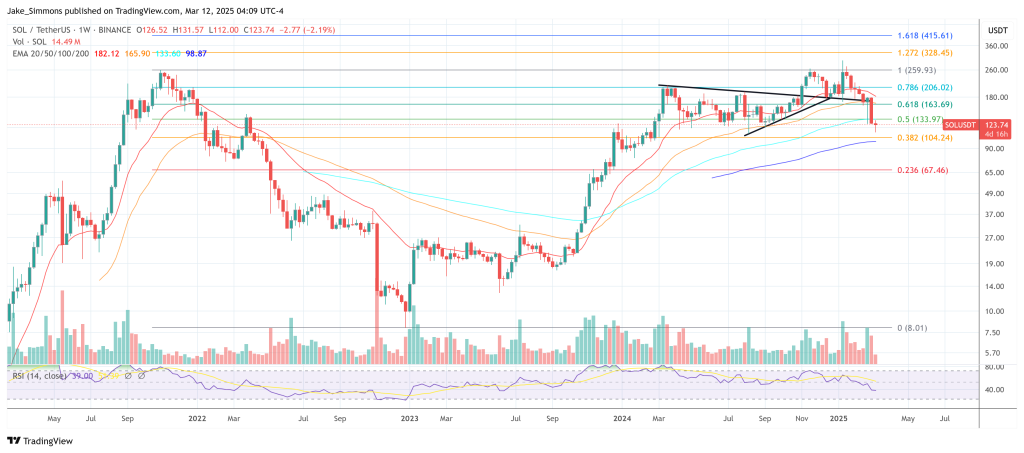
At press time, SOL traded at $123.