• Coins MarketCap
    • Coins MarketCap
    • Crypto Calculator
    • Top Gainers and Loser of the day
  • Crypto Exchanges
  • Bitcoin News
  • Crypto News
    • Cryptocurrency
    • Blockchain
    • Finance
    • Investing
    • View all latest Updates regarding crypto
Tuesday, October 7, 2025
WIREOPEDIA
No Result
View All Result
Contribute!
CONTACT US
  • Home
  • Breaking News
  • World
  • UK
  • US
  • Entertainment
  • Business
  • Technology
  • Defense
  • Health Care
  • Politics
  • Strange
  • Crypto News
WIREOPEDIA
  • Home
  • Breaking News
  • World
  • UK
  • US
  • Entertainment
  • Business
  • Technology
  • Defense
  • Health Care
  • Politics
  • Strange
  • Crypto News
No Result
View All Result
WIREOPEDIA
No Result
View All Result
Home Blockchain

The NSA Is Trying To Backdoor Bitcoin, Warns Peter Todd — Here’s How

by wireopedia memeber
October 7, 2025
in Blockchain, Crypto, Crypto Market, Cryptocurrency, Finance, Investing, Market
0
74
SHARES
1.2k
VIEWS
Share on FacebookShare on Twitter

Prominent Bitcoin developer Peter Todd alleged on Monday, October 6, that the US National Security Agency (NSA) is “looking to backdoor crypto again” via the rollout of so-called quantum-secure algorithms—this time by pushing deployments that exclude tried-and-tested classical cryptography.

You might also like

The Future of Finance Is On-Chain: RWA Inc. Launches First-Ever On-Chain Referral System for Real-World Asset Tokenization

India slams ‘unbacked crypto’ amid RBI’s new digital currency plans

Tokenization Set to Reshape Traditional Finance, Says Deloitte Survey, As Best Wallet Soars

“Tl;dr: the NSA is clearly looking to backdoor crypto again with the rollout of “quantum secure” algorithms. The obvious way to implement them is AND: traditional AND quantum secure. So you need to break both. The NSA is trying to remove that seatbelt: quantum-only,” Todd wrote.

Is The NSA Plotting A Quantum Backdoor Into Bitcoin?

Todd’s comments came as cryptographer Daniel J. Bernstein (DJB) published a pair of blog posts—on October 4 and 5—criticizing current Internet Engineering Task Force (IETF) processes and warning that “weakened cryptography” could be standardized through procedural changes that suppress dissent.

In “MODPOD: The collapse of IETF’s protections for dissent,” Bernstein argues that a new moderation framework enables content-based censorship of objections, including objections to eliminating “hybrid” deployments that combine classical and post-quantum schemes. He adds there is “useful action” stakeholders can take by Tuesday, October 7 to oppose these changes.

At the heart of the dispute is whether migrations to post-quantum cryptography (PQC) should favor hybrid combinations—e.g., classical ECDH and PQ key encapsulation—rather than quantum-only switches. Hybrids hedge the unknowns of newly standardized PQC by requiring an attacker to break both components to compromise a session or signature. The IETF formalized the term “hybrid” in June 2025 (RFC 9794), and NIST’s own guidance and FAQs likewise describe and allow hybrid key-establishment modes during transition. That context underpins Todd’s claim that pushing “quantum-only” is a dangerous deviation from best practice.

Bernstein’s companion post on October 4 details real-world hybrid deployments—Google’s CECPQ1/2 experiments (ECC+NewHope, ECC+NTRU, ECC+SIKE), multi-vendor SSH support for ECC+sntrup761, and today’s browser usage dominated by ECC+ML-KEM (Kyber)—as evidence that hybridization is already mainstream and operationally feasible at Internet scale. The post argues that eliminating hybrids would lower safety margins precisely when new PQC is still maturing.

NIST, for its part, has led the global PQC program since 2016 and in August 2024 finalized standards for ML-KEM (Kyber) and two signature schemes (ML-DSA/Dilithium and SLH-DSA/SPHINCS+), with additional algorithms such as HQC selected in 2025. Throughout its materials, NIST acknowledges hybrid modes as legitimate transition mechanisms and has hosted dedicated workshops on KEM guidance—positions that cut against a blanket “quantum-only” mandate.

Why this matters for Bitcoin and broader crypto is twofold. First, Bitcoin’s ecosystem relies heavily on standardized primitives and network protocols—hashes, signatures, handshakes—whose evolution is shaped by NIST and IETF outputs even when implementation occurs in open-source codebases. Second, Todd grounds his warning in history: the NSA’s alleged role in the Dual_EC_DRBG fiasco two decades ago, where a NIST-endorsed random number generator was later withdrawn amid credible backdoor concerns, including reports that RSA made it the default in its toolkit following a secret payment. “Endorsement of backdoored crypto has happened before at the behest of the NSA,” Todd wrote, adding “It’s not a theoretical risk. They’re clearly gearing up to do it again.”

There is, however, no public proof that the NSA is currently inserting a specific backdoor into NIST’s PQC standards or IETF drafts. NIST continues to publish open guidance, workshops, and public comment processes around PQC, including explicit documentation of hybrid approaches. Developer Fudmottin (@Fudmottin) objected to Todd: “If NIST endorsed cryptographic algorithms such as SHA-256 turn out to have back doors or a weakness, then NIST is done. No one will even ask them about the time of day (yes, NIST keeps that standard for the USA).”

The immediate call to action comes from Bernstein’s posts urging stakeholders to engage IETF mechanisms by Tuesday, October 7 (any time zone) to object to MODPOD-style moderation and to defend hybrid cryptography as the default transition path. Todd’s amplification into the Bitcoin community underscores a longstanding mistrust of intelligence-led cryptographic policy—shaped by Dual_EC and other episodes—and a desire to keep consensus-critical systems insulated from standards that may weaken defense-in-depth.

At press time, Bitcoin traded at $134,545.
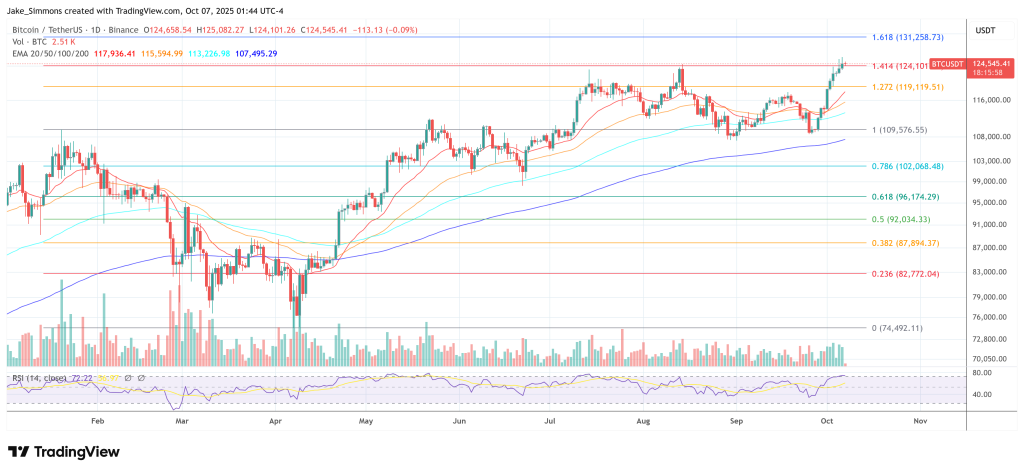
Bitcoin price

Read Entire Article
Tags: BitcoinistBlockchainCoin SurgesCryptocurrenciesMarket StoriesTrading
Share30Tweet19

Leave a Reply Cancel reply

Your email address will not be published. Required fields are marked *

Related News

Layer 1, 2, 3, parachain, sidechain – What’s the difference?

Layer 1, 2, 3, parachain, sidechain – What’s the difference?

May 13, 2024
People Are Sharing The Surprisingly Wholesome Moments They Had With Celebrities, And Suddenly The World Doesn’t Seem So Bad

People Are Sharing The Surprisingly Wholesome Moments They Had With Celebrities, And Suddenly The World Doesn’t Seem So Bad

July 14, 2025
US Bitcoin ETFs Surge by $202M While Ethereum ETFs Bleed $13M in Outflows

US Bitcoin ETFs Surge by $202M While Ethereum ETFs Bleed $13M in Outflows

August 27, 2024

Browse by Category

  • Blockchain
  • Breaking News
  • Business
  • Crypto
  • Crypto Market
  • Cryptocurrency
  • Defense
  • Entertainment
  • Finance
  • Health Care
  • Investing
  • Market
  • Politics
  • Strange
  • Technology
  • UK News
  • US News
  • World
WIREOPEDIA

Wireopedia is an automated news feed. The Wireopedia AI pulls from sources with different views so you can see the various sides of different arguments and make a decision for yourself. Wireopedia will be firmly committed to the public interest and democratic values.

Privacy Policy     Terms and Conditions

CATEGORIES

  • Blockchain
  • Breaking News
  • Business
  • Crypto
  • Crypto Market
  • Cryptocurrency
  • Defense
  • Entertainment
  • Finance
  • Health Care
  • Investing
  • Market
  • Politics
  • Strange
  • Technology
  • UK News
  • US News
  • World

BROWSE BY TAG

Bitcoin Bitcoinist Bitcoinmagazine Blockchain Breaking News Business BuzzFeed Celebrity News Coin Surges Cointelegraph Cryptocurrencies Cryptoslate Defense Entertainment Health Care insidebitcoins Market Stories newsbtc Politico Skynews Strange Technology Trading UK US World

RECENT POSTS

  • Capitol agenda: At least they’re talking about talking
  • Sea life park ‘threatens to euthanise 30 whales’ in row with government
  • Bird of prey suffered ‘harrowing death’ after being poisoned
  • Robin Williams’s daughter begs people to stop sending her AI videos of her father
  • The Future of Finance Is On-Chain: RWA Inc. Launches First-Ever On-Chain Referral System for Real-World Asset Tokenization

© 2024 WIREOPEDIA - All right reserved.

No Result
View All Result
  • Home
  • Breaking News
  • World
  • UK
  • US
  • Entertainment
  • Business
  • Technology
  • Defense
  • Health Care
  • Politics
  • Strange
  • Crypto News
  • Contribute!

© 2024 WIREOPEDIA - All right reserved.

  • bitcoinBitcoin(BTC)$124,534.000.04%
  • ethereumEthereum(ETH)$4,708.572.67%
  • binancecoinBNB(BNB)$1,306.845.84%
  • rippleXRP(XRP)$2.97-1.04%
  • tetherTether(USDT)$1.000.02%
  • solanaSolana(SOL)$229.79-1.90%
  • usd-coinUSDC(USDC)$1.00-0.01%
  • staked-etherLido Staked Ether(STETH)$4,703.882.60%
  • dogecoinDogecoin(DOGE)$0.2618440.39%
  • tronTRON(TRX)$0.3445940.40%
  • cardanoCardano(ADA)$0.860.57%
  • wrapped-bitcoinWrapped Bitcoin(WBTC)$124,256.00-0.32%
  • chainlinkChainlink(LINK)$22.802.28%
  • stellarStellar(XLM)$0.400508-1.34%
  • avalanche-2Avalanche(AVAX)$29.90-2.40%
  • bitcoin-cashBitcoin Cash(BCH)$592.56-1.24%
  • litecoinLitecoin(LTC)$118.17-1.60%
  • shiba-inuShiba Inu(SHIB)$0.0000130.11%
  • crypto-com-chainCronos(CRO)$0.204930-1.85%
  • polkadotPolkadot(DOT)$4.331.90%
  • okbOKB(OKB)$231.561.24%
  • uniswapUniswap(UNI)$8.11-2.05%
  • daiDai(DAI)$1.00-0.07%
  • nearNEAR Protocol(NEAR)$3.031.01%
  • vechainVeChain(VET)$0.023156-0.98%
  • algorandAlgorand(ALGO)$0.2262681.08%
  • cosmosCosmos Hub(ATOM)$4.210.89%
  • filecoinFilecoin(FIL)$2.390.98%
  • elrond-erd-2MultiversX(EGLD)$13.990.09%
  • axie-infinityAxie Infinity(AXS)$2.272.50%