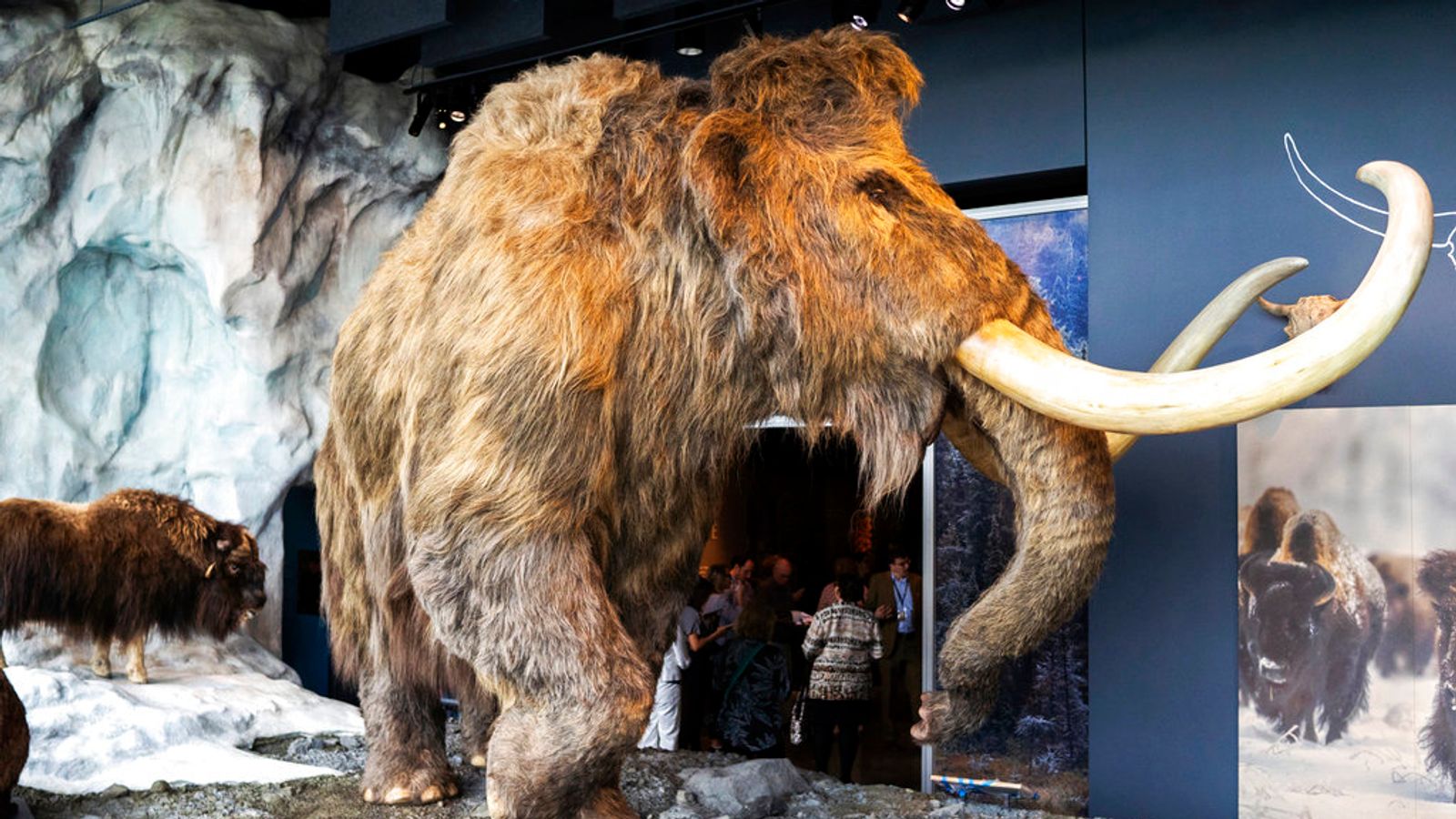
The idea of scientists bringing pre-historic creatures back to life with some clever DNA trickery might sound familiar to fans of the 1993 Hollywood blockbuster Jurassic Park.
But for Colossal Biosciences – a company that hopes to reintroduce extinct species such as the dodo and the mammoth – it is more than just a film script.
It’s a reality – and one that could be just years away.
“We’ve got all the technology we need,” says Ben Lamm, chief executive of the firm, based in Dallas, Texas.
“It is just a focus of time and funding. But we are 100% confident [we can bring back] the Tasmanian tiger, the dodo, and the mammoth.”
The science behind the project is simple: Work out the genes that make an extinct animal what it is, and then replicate those genes using the DNA of a close existing relative.
“It’s almost reverse Jurassic Park,” says Mr Lamm, speaking to Sky News.
“In the film, they were filling in the holes in the dinosaur DNA with frog DNA.
“We are leveraging artificial intelligence and other tools to identify the core genes that make a mammoth a mammoth and then engineering them into elephant genomes.”
That is the technical part.
But there are some other practical hurdles for Colossal to overcome, namely how, once you have mammoth cells, do you birth a real-life mammoth?
The answer, according to Colossal, is in the womb of an Asian elephant.
But it is a process that could take nearly two years, even after they have worked out how to do it.
“[Each of the] different projects [the mammoth, dodo, and Tasmanian tiger] have different challenges – the mammoth is really around gestation – which is around 22 months,” says Mr Lamm.
“The dodo gestation is pretty great – we are using surrogate chickens. The hardest part is cultivating the primordial germ cells.”
‘Feeling good about 2028’
So after around 4,000 years of extinction, when could we see the return of the mighty mammoth – a creature that fell victim to human hunting and the changing conditions brought about by the end of the last Ice Age.
“We are well into the editing phase,” says Mr Lamm.
“We don’t have mammoths yet, but we still feel very good about 2028.”
Away from the lab, led by Eriona Hysolli, Colossal’s head of biological sciences, there are other issues to overcome – including where the newly returned species will live once they are born.
Mr Lamm says the company is already working with local governments, conservation groups, indigenous people groups, private land lowers, and the public at large, to prepare for the animals to be returned to their natural habitat.
“Our ultimate goal is to put all the animals we make back into the wild,” he says.
‘New tools in the fight’ to protect nature
Colossal says the work is not just about rewilding animals previously lost to the world.
The company is currently working with Dr Paul Ling at Baylor College of Medicine in Houston, Texas, to create a vaccine to eradicate the deadly EEHV virus – which kills around 20% of baby elephants each year.
It is also working closely with the University of Alaska and the University of Stockholm on radiocarbon dating of American mammoths as well as sequencing their genome – the largest study of its type ever undertaken.
Be the first to get Breaking News
Install the Sky News app for free
Read more:
Colossal Biosciences announces project to bring back the dodo
Scientists unveil 240-million-year-old reptile likened to ‘Chinese dragon’
Mr Lamm also hopes that, through Colossal’s research, the company can tackle issues facing the world today, including a drop in biodiversity.
“I think we have a duty to this planet that we’ve been given – we are tending towards a loss of up to 50% biodiversity if we don’t do anything,” he says.
“Modern conservation is great, but we need new tools in the fight.
“Work on de-extinction goes hand-in-hand with species preservation, and if Colossal makes a couple of technologies, then maybe it will provide those tools.”
‘Jurassic Park helps people understand our work’
As for the Jurassic Park comparisons, well, there is one small issue, according to Mr Lamm.
In the Steven Spielberg-directed epic, the scientists use DNA embedded in fossilised mosquitoes in amber combined with frog DNA to bring dinosaurs back to life.
“Amber is not a good holder of DNA,” Mr Lamm says.
“But it’s a very entertaining movie and I think Jurassic Park made a lot of people interested in science. I saw it when I was younger and I was like: ‘Wow genetics is cool’.
“It did a lot to explain to the masses that genetic engineering is a thing and something that can be used in powerful ways, and I do think more people understand Colossal because of that.”
The company is also working on a film of its own, and, luckily for everyone, it’s not a dystopian thriller like Jurassic Park.
It has teamed up with award-winning director James Reed, a specialist in nature films, to document its “de-extinction” work.
“It’s really exciting. When you are doing anything bold, it is important to communicate and be transparent, and there’s nothing more transparent than having cameras around all the time,” says Mr Lamm.