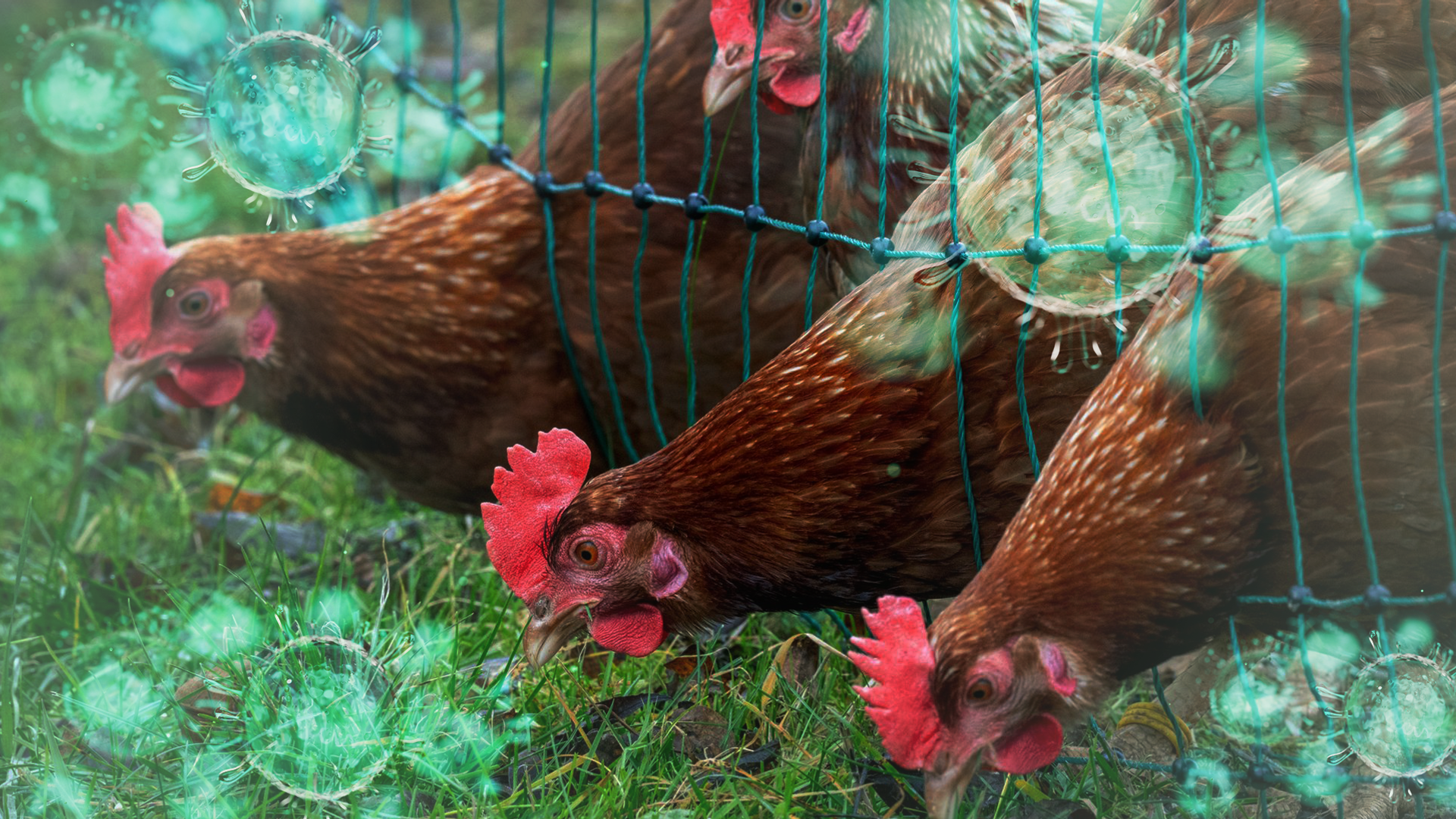
The UK has been declared an Avian Influenza Prevention Zone (AIPZ) – and bird “gatherings” have been banned in England and Wales in response to rising cases of bird flu.
Strains of the virus have been reported in poultry and wild birds across the country – and one person working on a farm in the West Midlands.
Although there has only been one human case, the government has ordered five million doses of a bird flu vaccine to prevent further spread between humans.
Human-to-human transmission has not happened in the UK or Europe since bird flu first emerged in 1997, but experts warn each infection increases the risk of the virus adapting to human hosts – and causing a pandemic. Here is what you need to know.
What is avian flu – and how does it spread?
Avian flu (more commonly known as bird flu) is an influenza virus most common in wild birds and poultry. It can spread to mammals – and very rarely to humans.
It is spread through contact with infected birds, or other species, including through touching their droppings and bedding.
Humans can also catch the virus by killing or preparing infected poultry for cooking.
According to the Health and Safety Executive (HSE), people who work with birds are most likely to contract it by breathing in dust and mist generated by infected birds – or touching infected equipment or machinery.
Symptoms in birds include sudden death, a swollen head, and closed or runny eyes. Mortality rates in chickens and other poultry are close to 100%.
Ducks, geese, and swans do not always show symptoms, which means they can spread the virus undetected. Scientists at the University of Glasgow recently found that horses were also asymptomatic for bird flu, sparking concerns the scale of the global outbreak could be higher than previously thought.
In humans, symptoms develop between three and five days after exposure and include:
It is different from seasonal influenza which infects humans each winter. This year the most common strains are A(H1N1) and A(H3N2).
Like seasonal influenza however, in humans it can cause pneumonia, acute respiratory problems, and sometimes death – particularly in vulnerable people.
How widespread is the UK outbreak – and beyond?
The current outbreak stretches back to 2020 when the virus spread widely across Europe, Asia, Africa, the Americas, and Antarctica.
By 2021 and 2022 sea birds along the UK coastline were dying – and eventually the virus spread to non-wild birds – including poultry.
The current poultry outbreak began with the (HPAI) H5N5 strain being identified in England on 5 November last year – and the (HPAI) H5N1 strain 12 days later. There has now been one case of each confirmed in Scotland – and just over 30 of the latter in England.
Most cases are in the east of England – from Essex and Suffolk to Yorkshire. The West Midlands, Merseyside, parts of Cornwall, Rye in Sussex, and Flintshire in Wales have also been impacted.
Read more
Restrictions across England and Scotland
Nationwide US milk testing for bird flu in cows
Bird flu found in king penguins for first time
There has only been one human case in the UK. The patient is “currently well” and being treated at a high-consequence infectious disease unit to prevent further transmission, the government says. Their closest contacts have been given antiviral drugs.
Beyond the UK, a slightly different strain has spread to about 156 million birds in the US as well as jumping to dairy cows – closing bird and cattle markets in certain states.
Almost 70 human cases have been confirmed there, including one fatal one in Louisiana in January – in a patient over the age of 65. Another fatal case has been reported in Mexico, and a teenage girl in Canada became seriously ill from the virus last year but was discharged last month.
Human-to-human transmission is confined to a small number of cases in Thailand, Hong Kong and Indonesia.
Please use Chrome browser for a more accessible video player
How likely is further human spread in the UK?
Although both strains are “highly pathogenic” – this only refers to the risk to birds – not humans.
And according to the UK Health Security Agency (UKHSA), the risk to the general public is “very low”.
“For most people, it’s not a direct threat at the moment,” Professor Ed Hutchinson, professor of molecular and cellular virology at the University of Glasgow, told Sky News.
“Flu viruses can adapt to new host species – they do it far more than any other virus – but it’s still very hard for them to do,” he said. “As a result, new flu strains only jump into humans every few decades.”
This is because to infect a human and create a viral load large enough to spread to other humans, the virus needs to adapt in three ways.
First, it must attach itself to the sugar molecules on the surface of our cells, before it can infect them by interacting with molecules inside – and both these types of molecules are structured differently in humans and birds.
Finally, it needs to be able to fight off the immune system – and our immune systems operate differently to the ones birds have.
“So far it hasn’t been able to adapt enough to jump from human to human, so that’s good news,” Prof Hutchinson said.
“For the time being we’re only at the first step of what progression to a human adapted virus looks like.”
But, he stressed: “The virus is already doing a lot of the things that would count as early warning signs for a possible future pandemic – and every infection of a human is another opportunity for it to adapt.
“So it’s rightly being viewed with a lot of concern. But that does not mean it’s necessarily capable of causing a pandemic, and even if there is still time to intervene to reduce the risk of it doing so.”
Follow our channel and never miss an update
How can we stop it spreading?
Birds are not vaccinated for bird flu in the UK and are scarcely given antiviral medication to prevent drug resistance.
The restrictions currently in place for bird owners largely work by segregating commercial, and domestic birds from wild flocks – as the virus is harder to monitor in wild populations.
Poultry farmers with cases are forced to cull most of their other livestock within a certain radius, which is devastating for livelihoods – and pushes up the price of eggs and other poultry products.
If you see a dead bird with any of the key symptoms – you should report it to the government’s Department for Environment, Food and Rural Affairs (DEFRA) by phone or online. The British Trust for Ornithology (BNO) also has an online tracker people can use that monitors the virus’s spread in near-real time.
If possible, preventing pets from scavenging dead birds can help stop the spread – particularly waterfowl or seabirds as they are the main carriers.
Eating eggs or cooked poultry does not risk any spread as neither of them contain any of the living organisms flu viruses need to survive.
In the US where cows have become infected, the virus will only survive in milk that hasn’t been pasteurised – as heat kills it instantly.
Be the first to get Breaking News
Install the Sky News app for free
What restrictions are in place?
All four UK nations are currently designated Avian Influenza Prevention Zones.
From pet birds to a commercial flock, owners are required to keep them away from wild birds, free from rodents or pests, and to disinfect their pens, clothing, and anything else that comes into contact with their birds, bedding, or faeces.
Movement of birds and human contact should be minimised – and all activity monitored, the guidance adds.
People who own more than 50 birds must have government-mandated disinfectant foot dip at all entry and exit points.
Members of the public are banned from feeding wild game birds within 500m of any premises with more than 500 poultry or captive birds (kept as pets or in zoos).
In the East of England and Shropshire, stricter restrictions require all birds to be kept inside.
Any cases of highly pathogenic bird flu trigger a 3km (1.9-mile) protection zone and 10km (6.2-mile) surveillance zone around them.
As of midday on 10 February in England and Wales, bird “gatherings” of ducks, geese, swans, pheasants, partridge, quail, chickens, turkeys, and guinea fowl are banned.
These include bringing birds together for fairs, markets, sales, exhibitions – or transporting a group from different premises together.